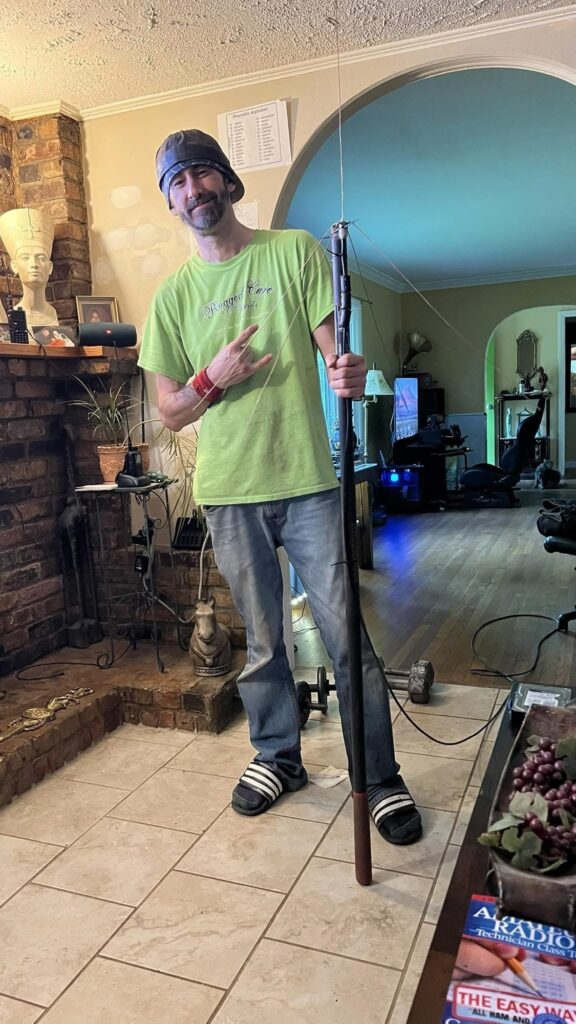
Building your very own 1/4 wave ground plane antenna is easier than you think. With a few tools, a bit of 14-gauge copper wire, and LMR-400 coax cable, you can build a reliable HAM or GMRS radio antenna. It is a DIY project that boosts your signal, puts dollars in your pocket, and informs you on how antennas really work.
A 1/4 wave ground plane antenna for HAM radio is simple, inexpensive, and perfect for anyone who wants a hands-on experience working with antenna theory.
For more beginner projects, visit RadioOpBox.com Antenna Guides.
What is a 1/4 Wave Ground Plane Antenna?
A 1/4 wave ground plane antenna is one of the most widely used and efficient local VHF or UHF antennas. It consists of:
- 1 vertical radiator
- 4 radials sloping downwards to form the ground plane.
This design produces an omnidirectional radiation pattern, which is ideal for repeater access or simplex use.
Benefits:
Easy to build and tune
Excellent local coverage
Very low cost
Drawbacks:
Bandwidth limited
Needs to be mounted properly for good performance
Materials You’ll Need
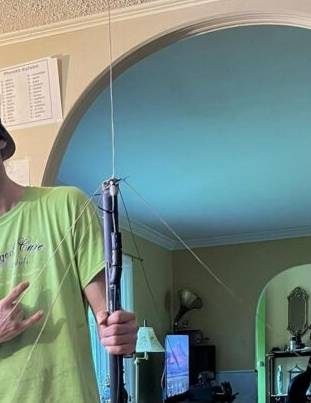
14-gauge copper wire antenna construction example
Below is what you’ll need for your 1/4 wave ground plane antenna built using 14-gauge copper wire and LMR-400:
(Affiliate links help support RadioOpBox.com at no extra cost.)
- SO-239 Panel Connector – base of the antenna
- 14 AWG Solid Copper Wire – for radiator and radials
- LMR-400 Coax Cable 50ft – premium low-loss, high-quality coax
- Soldering Iron Kit – for quality joints
- Drill, screws, and mounting hardware
???? Pro Tip: Low-resistance, high-conductivity copper wire improves SWR and signal efficiency. LMR-400 coax reduces signal loss, especially on long lengths.
Step-by-Step: Building a 1/4 Wave Ground Plane Antenna
Step 1: Calculate the Wire Lengths
Use the formula:
Length (inches) = 2808 / Frequency (MHz)
Example for 146 MHz (2-meter band):
2808 ÷ 146 = 19.2 inches
✅ Radiator: 19.2″ of 14-gauge copper wire
✅ Radials (4 total): Each 19.2″ of 14-gauge copper wire
Step 2: Prepare the SO-239 Base
The SO-239 connector is the center hub:
Center pin: vertical radiator
Outer flange: four radials
If your connector is not pre-drilled with holes for radials, create small holes near the edges so that the wires can be tightly attached.
Step 3: Install the Radiator
Cut away ½″ insulation and solder the vertical radiator wire to the center pin.
Straighten it out — alignment will affect antenna radiation pattern.
Step 4: Install the Ground Radials
Securely fasten the four radials evenly spaced apart.
Fold each one down at a 45° angle to have about 50 ohms impedance for optimum radio performance.
Step 5: Install the Antenna
Mount the antenna to a PVC pipe or mast with clamps or brackets.
Connect the PL-259 terminated LMR-400 coax cable to the SO-239 base.
For ideas on mounting, see: Building Your First HAM Base Station.
Step 6: Tune and Test
Use an SWR meter or antenna analyzer. Adjust the radiator so your SWR is nearly 1.0:1. Trim or extend wire with caution for fine-tuning.
Read more: How to Tune and Test Your Radio Antenna
Mount your antenna as high as possible for line-of-sight coverage.
Weatherproof solder joints with tape or sealant.
Keep radials symmetrical for optimal balance.
Recheck SWR every few months.
Using LMR-400 reduces signal loss over long coax runs.
Recommended Tools & Accessories
- NanoVNA Antenna Analyzer – precise tuning
- 14 AWG Solid Copper Wire Roll – enough for multiple builds
- Soldering Iron Kit with Stand – safe and professional assembly
- LMR-400 Coax Cable 50ft – high-quality, low-loss.
FAQ: Assembly of a 1/4 Wave Ground Plane Antenna
Q1: What frequency band is best for a 1/4 wave ground plane antenna?
A: Best for VHF and UHF, for example, 144–148 MHz or 440–450 MHz.
Q2: Can I use aluminum instead of copper?
A: Yes, but copper is easier to solder and gives better conductivity.
Q3: How high should I raise the antenna?
A: Best 10–20 feet off the ground for maximum line-of-sight coverage.
Q4: What coax should I use for maximum performance?
A: LMR-400 is best utilized for low-loss, long cable runs.
Conclusion
Building a 1/4 wave ground plane antenna is a rewarding DIY HAM project. With 14-gauge copper wire and LMR-400 coax, it’s easy, cheap, and provides excellent communications performance.
Building an antenna helps you understand tuning, impedance, and signal action — skills vital to any HAM or GMRS operator.
For additional HAM and GMRS tutorials, guides, and equipment reviews, visit RadioOpBox.com.

Leave a Reply