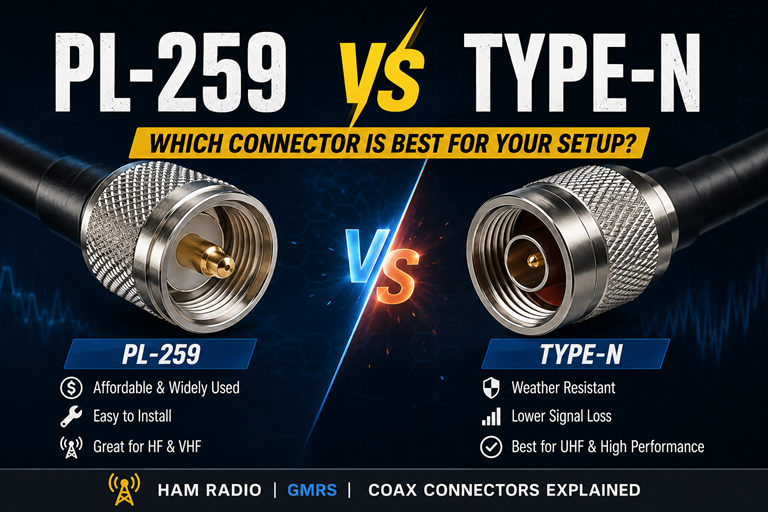
If you’re building a HAM or GMRS radio setup, your coax connectors matter more than most operators realize.
A bad connector choice can increase signal loss, reduce reliability, and hurt overall performance—especially at UHF frequencies.
That’s why understanding the differences between PL-259 vs Type-N connectors is critical if you want the best performance from your station.
In this guide, we’ll break down the real-world pros and cons of each connector type and explain which one is best for HAM radio, GMRS, repeaters, and base station setups.
🔍 What Is a PL-259 Connector?
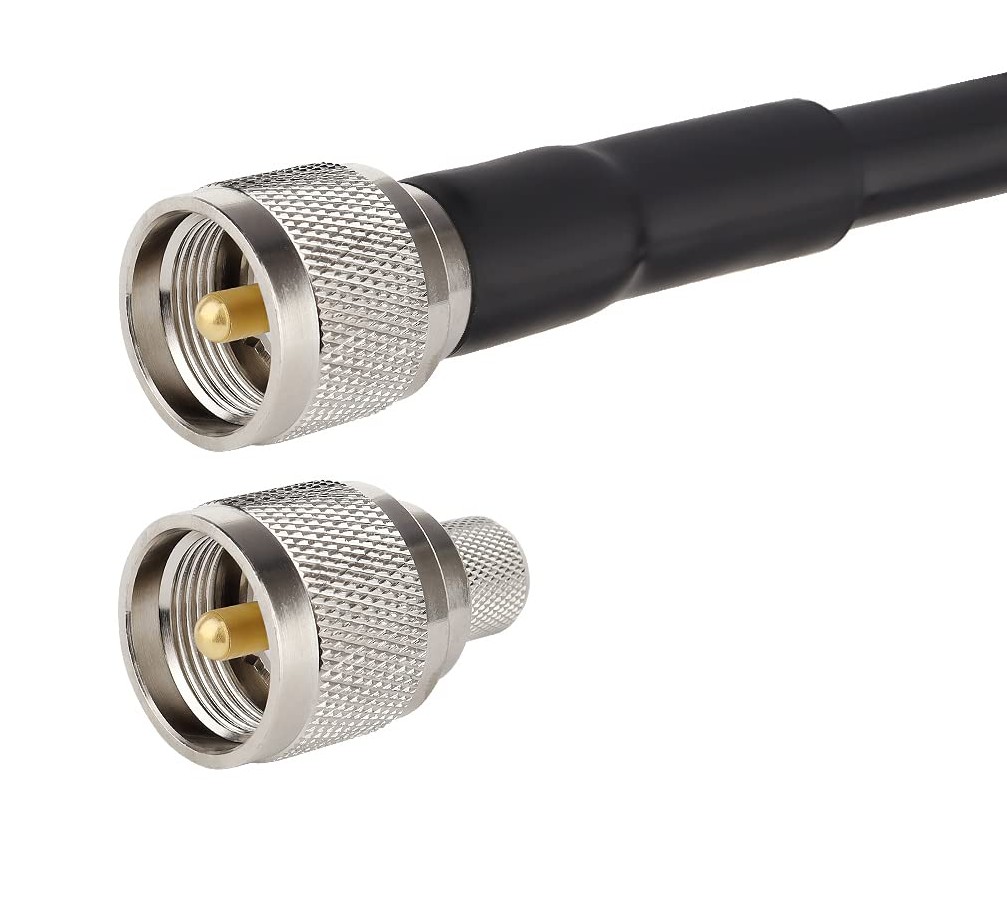
The PL-259 connector (commonly called a UHF connector) has been used in HAM radio for decades.
It remains one of the most common coax connectors because it’s affordable, easy to install, and compatible with many older radios and antennas.
✅ Benefits of PL-259 Connectors
- Affordable and easy to find
- Beginner-friendly installation
- Common on HAM radio equipment
- Works well on HF and lower VHF frequencies
❌ Downsides of PL-259 Connectors
- Higher signal loss at UHF frequencies
- Not naturally weatherproof
- Not a true 50-ohm connector
- Can loosen over time outdoors
👉 Recommended PL-259 connectors:
https://amzn.to/4tkccw4
For casual HAM radio setups, PL-259 connectors still work fine. But once you move into GMRS, repeaters, or long coax runs, the limitations start showing.
🔍 What Is a Type-N Connector?
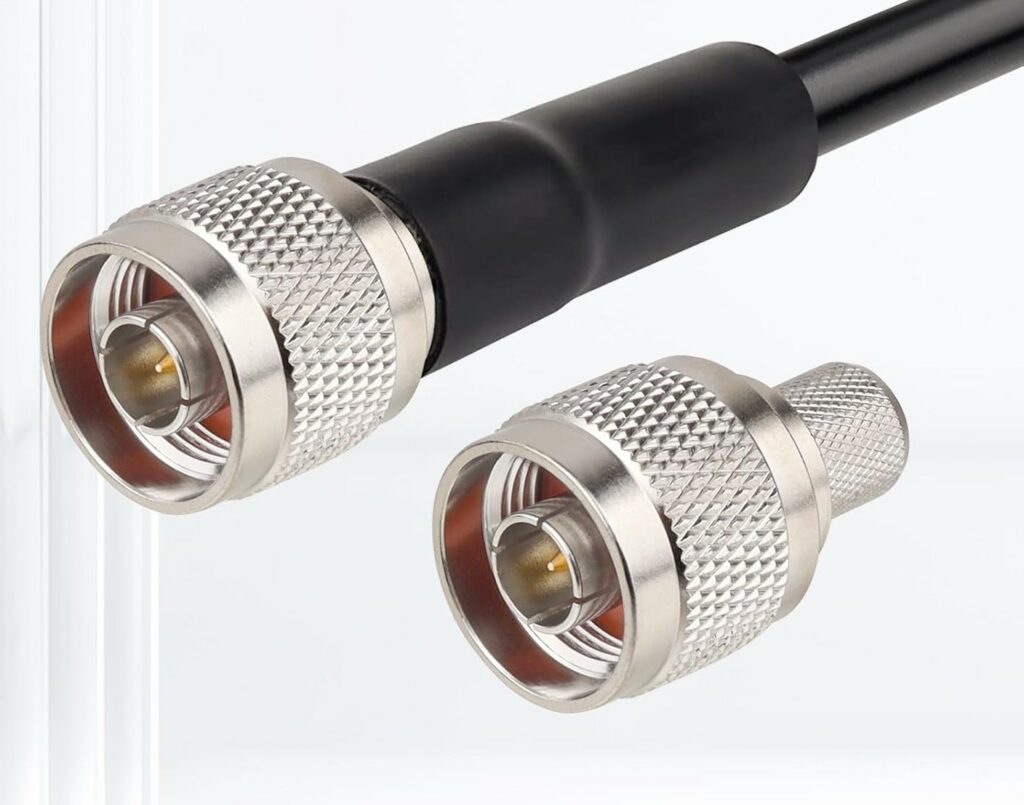
The Type-N connector is a precision RF connector designed for higher performance and lower loss.
Unlike PL-259 connectors, Type-N connectors maintain true 50-ohm impedance and provide significantly better performance at UHF frequencies.
This is why many commercial radio systems, repeaters, and serious GMRS operators prefer them.
✅ Benefits of Type-N Connectors
- Lower signal loss
- True 50-ohm impedance
- Excellent weather resistance
- More secure threaded connection
- Better for UHF and GMRS frequencies
❌ Downsides of Type-N Connectors
- Slightly more expensive
- Installation can be more complex
- Not as common on older radio gear
👉 Recommended Type-N connectors:
https://amzn.to/4nhLDGA
⚔️ PL-259 vs Type-N Connectors (Real-World Comparison)
When comparing PL-259 vs Type-N connectors, the biggest differences come down to signal performance, durability, and frequency handling.
📡 Signal Loss
- PL-259: Higher signal loss at UHF
- Type-N: Lower loss and cleaner signal path
🌧 Weather Resistance
- PL-259: Requires additional sealing outdoors
- Type-N: Naturally weather-resistant design
📶 Frequency Performance
- PL-259: Best for HF and basic VHF setups
- Type-N: Ideal for GMRS, UHF, repeaters, and long runs
🔩 Durability
- PL-259: Can loosen or corrode over time
- Type-N: Secure threaded design with better longevity
👉 Looking for low-loss coax that actually performs under load?
Check out our tested KMR400 setup:
https://radioopbox.com/product/kmr400-coaxial-cable-50-ohm-low-loss/
📡 Which Connector Is Best for HAM & GMRS?
Here’s the honest answer:
Use PL-259 If:
- You mainly operate HF
- You want the cheapest option
- Your runs are short
- You’re using older equipment
Use Type-N If:
- You operate GMRS or UHF
- You care about minimizing signal loss
- Your antenna is outdoors
- You’re building a repeater or serious base station
For modern GMRS systems and high-performance HAM setups, Type-N connectors are usually the better investment.
🔗 Best Cable + Connector Setup (What We Recommend)
For best performance, your coax cable matters just as much as your connectors.
If you’re serious about reducing signal loss and improving range, pairing the right cable with the right connector is critical.
- Use LMR-400 / KMR400 coax
- Pair with Type-N connectors
- Keep runs as short as possible
- Avoid unnecessary adapters
👉 Recommended high-performance coax cable (LMR/KMR400):
https://radioopbox.com/product/kmr400-coaxial-cable-50-ohm-low-loss/
This is the same type of low-loss coax used in serious HAM, GMRS, and repeater setups where every dB matters.
💡 Pro Tip: Avoid Excessive Adapters
Every connector and adapter introduces additional signal loss.
This setup:
Radio → Adapter → Cable → Adapter → Antenna
…can seriously hurt performance.
Instead:
✔ Match your antenna and radio connector types
✔ Use direct cable runs whenever possible
✔ Minimize unnecessary connection points
👉 Recommended adapter option if needed:
https://amzn.to/4uzhXam
🧠 Final Verdict: PL-259 vs Type-N Connectors
If you want a simple, budget-friendly option for basic HAM radio use, PL-259 connectors still work.
But if you want the best possible performance for GMRS, UHF, repeaters, or long-distance communication, Type-N connectors are the clear winner.
The combination of:
- Lower signal loss
- Better weather resistance
- Improved durability
- True 50-ohm impedance
…makes Type-N the better long-term investment for most modern radio setups.
🔗 Related Articles
👉 LMR-400 vs RG8X Coax Cable
https://radioopbox.com/lmr-400-vs-rg8x-coax-cable/
👉 KMR400 Low-Loss Coax Cable
https://radioopbox.com/product/kmr400-coaxial-cable-50-ohm-low-loss/
⚠️ Affiliate Disclosure
Some links in this article may be affiliate links, meaning we may earn a commission if you purchase through them at no extra cost to you. We only recommend products we actually trust and use in real HAM & GMRS environments.

Leave a Reply